
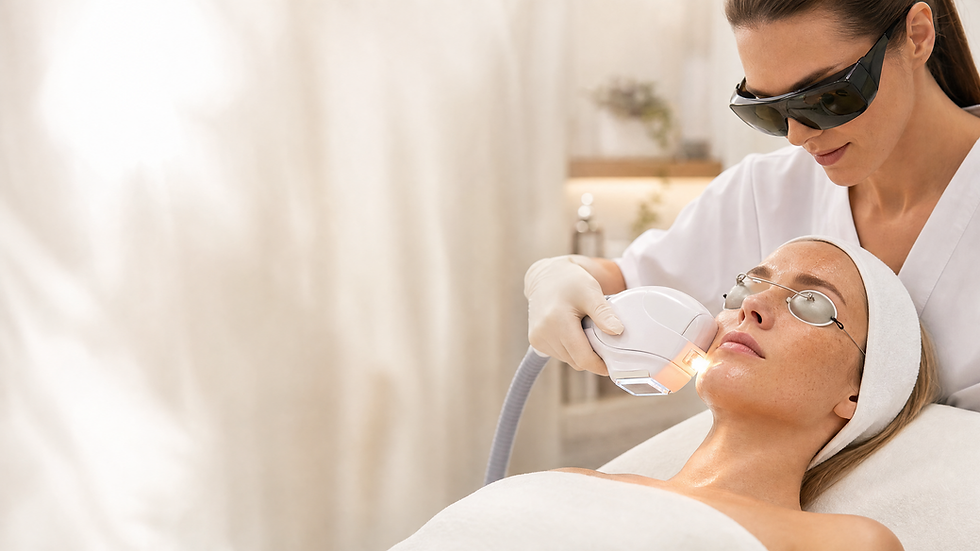
How long an IPL appointment takes
An IPL session at The Spa by Sheena runs 30 to 60 minutes depending on the area treated. Clearing sun damage and redness commonly takes three to six sessions, a few weeks apart.
What kind of treatment is IPL?
A light-based treatment performed by Becca (MSN, FNP-C) or Angie (RN) under our medical director, Dr. Arledge, a plastic surgeon. IPL is intense pulsed light, not a laser.
Where we run IPL
Priced per area: hands, neck, half arms, décolletage, face, half legs, full arms, back, face and neck, or full legs.
What IPL photofacial treats
For sun spots, freckling, rosacea-pattern redness and uneven tone. IPL is safest on lighter, untanned skin (Fitzpatrick I–III); on darker or tanned skin it carries a real risk of burns and lasting pigment change.
Inside a 30-to-45-minute IPL appointment
Our IPL Photo Facial Services
Intense pulsed light for sun damage, brown spots and redness
What is an IPL Photo Facial?
IPL photofacial is our treatment for sun damage. If you have brown spots on your hands, chest, or face from the West Texas sun; if you have rosacea-pattern redness that flushes at the drop of a hat; or if the tone of your skin has gotten uneven with age, IPL is the fastest way to reset it. Intense pulsed light delivers multiple wavelengths at once, which is why one treatment addresses pigmentation and redness in the same session.
IPL is not a laser. A laser uses one wavelength; IPL uses a broadband range of visible light (usually 500 to 1200 nanometers) filtered to target specific structures. The pigmented cells and dilated capillaries absorb the light and heat up, and your body clears the damaged tissue over the following week. IPL treatment is FDA-cleared and has been in clinical use for decades. Some spas market a related device called BBL (broadband light), which is Sciton's specific branded version of IPL. Both use the same underlying technology.
Pricing is per area, per session. The face IPL and décolletage IPL both run $400. Face plus neck combined runs $650. Hands run $250. Neck alone is $325. Half-arms run $350, full arms $475. Half-legs run $450, full legs $650. Back is $575. Most clients start with the face or the area that bothers them most and add on as they see results.
Most clients need 3 to 4 IPL sessions spaced 4 to 6 weeks apart for full clearance. Between sessions, treated pigmented spots darken to look like coffee grounds for 5 to 10 days before flaking off, revealing clearer skin underneath. Cumulative results become obvious after the second or third session. For melasma specifically, IPL is not always the first choice. The heat can sometimes worsen melasma. If melasma is your primary concern, ask about our melasma-specific laser protocol at consultation.
IPL works best in fall and winter, when your skin is not actively tanning. Sun-exposed or freshly tanned skin cannot be treated safely, and self-tanner has to fully wear off before your first session. Strict SPF 30 daily for the two weeks before and four weeks after each session is non-negotiable. Skip retinoids, glycolic acid, and other exfoliants for one week before and one week after.
What to expect from an IPL Photo Facial
An IPL session takes 30 to 60 minutes depending on the area. The treatment feels like a strong rubber band snap or a brief heat pulse. A cooling tip helps manage the sensation. Eye shields are worn throughout.
Treated pigmented spots will darken (look like coffee grounds) for 5 to 10 days, then flake off naturally. Mild redness and swelling for 24 to 48 hours. The skin will look slightly worse before it looks better. Plan accordingly if you have social commitments.
Strict sun avoidance for 2 weeks before and 4 weeks after each session. SPF 30 minimum, daily. Skip retinoids and exfoliants for a week post-treatment. No picking at the darkened spots. Let them flake off naturally.

Benefits of IPL Photo Facials
FADED SUN DAMAGE
Targets and removes brown spots, freckles, and uneven pigmentation from years of sun exposure.
REDUCED REDNESS
Treats rosacea-related redness, broken capillaries, and overall facial flushing.
EVEN TONE
Restores uniform skin tone for a brighter, more youthful-looking complexion.
NO DOWNTIME
Mild redness for an hour, then back to normal—dark spots flake off naturally over 7 to 10 days.
PROVEN TECHNOLOGY
Intense Pulsed Light has been refining tone and texture for decades with a strong safety record.
Inside a 30-to-45-minute IPL appointment
Inside an IPL Photo Facial appointment
IPL stands for intense pulsed light. Even though it lives under our laser menu, it is not a laser. A laser fires one single wavelength of light. IPL sends out a broad band of light, roughly 500 to 1200 nanometers, in short, bright pulses, and filters shape that light toward what we want it to reach.
The science behind it is called selective photothermolysis. The light passes into the skin and gets absorbed by two things in particular: melanin, the pigment that makes brown spots brown, and hemoglobin, the red inside tiny blood vessels. Those targets soak up the energy, heat up, and break down, while the skin around them is largely left alone.
That is why IPL is used for the discoloration a West Texas sun tends to leave behind. It is used to fade sun spots and freckles (dermatologists call them solar lentigines), soften the diffuse redness and small visible vessels of a rosacea-pattern complexion, and even out patchy tone. It is not the right tool for every kind of pigment. Deeper melasma often behaves differently and can need a gentler, separate plan, which is why we treat melasma and pigmentation as its own conversation. IPL also does not resurface deep texture or lines. A consultation is where we sort out whether IPL, another of our laser and light treatments, or a combination actually fits your skin.
Avoid sun for 4 weeks before each session
Before your first IPL session
Here is the part people don't expect. In the days after a session, your brown spots usually get darker before they get better. They can turn to little flecks that look like coffee grounds or ground pepper, then flake off on their own over the next one to two weeks. Let them. Picking or scrubbing at them invites trouble. Downtime is otherwise mild. Most people head back to work the next day with some redness that feels like a light sunburn and covers easily with mineral SPF.
IPL is a series, not a one-and-done. Clearing sun damage and redness often takes a course of treatments, commonly three to six, spaced a few weeks apart, and your provider will tell you what your skin actually needs. We don't promise a specific result. Skin varies, and honest expectations are part of a good consultation.
Now the honest safety part, because it matters. IPL works by heating pigment, so it is safest on lighter, untanned skin (Fitzpatrick types I through III). On darker skin tones, or on skin with a fresh tan, the light cannot reliably tell your target pigment from the pigment in the surrounding skin. That raises a real risk of burns, blistering, and lasting dark or light patches. For deeper skin tones, IPL is often not the right call, and we will talk through alternatives at your consultation. Our PiQo4 laser facial and acne treatments use different technology and may be a better fit. Please come in without an active tan, and skip the tanning bed and self-tanner beforehand.
After your appointment, see our pigmentation laser aftercare guide for step-by-step recovery instructions and what to expect.
VIP members save 10% on every visit.
A few things rule IPL out, or mean waiting. It is not done during pregnancy. Some medications make skin more sensitive to light, including certain antibiotics such as doxycycline and other photosensitizing drugs, and recent isotretinoin (Accutane) usually means waiting around six months after your last dose. Bring your full medication list to your consultation so a provider can check.
FAQ
Your questions, answered
We’ve answered some of the most common questions below to help make your experience simple, transparent, and stress-free.
IPL (intense pulsed light) uses broad-spectrum light to target pigmented spots and visible blood vessels in the skin. The light is absorbed by pigment in sun spots, age spots, freckles, and redness from broken capillaries or rosacea. The treated lesions darken, then flake away over 7–14 days. Result: more even tone.
What is IPL and what does it treat?
Laser uses a single focused wavelength for targeted treatment. IPL uses a range of wavelengths simultaneously—better for treating multiple pigment and vascular issues at once. IPL is excellent for sun damage, redness, and overall tone. Specific lasers are better for tattoos, hair, and certain pigmentation issues.
What's the difference between IPL and laser?
A series of 2 to 4 sessions, scheduled 4 weeks apart, is typically recommended for optimal clearance. Annual follow-up treatments may be required to maintain results, especially with continued sun exposure.
How many IPL sessions will I need?
Like a rubber band snap on the skin. Each pulse takes a fraction of a second. The full-face treatment takes 15–30 minutes. Most patients describe it as more tolerable than expected. We can apply topical numbing for sensitive patients, but most don't need it.
Does IPL hurt?
Recovery is about 10 days. Mild redness for a few hours after treatment. The distinctive part: brown spots will darken significantly within 24 hours (looks like coffee grounds on your skin)—this is normal and expected. Those darkened spots will flake off over 7–10 days as your skin sheds. Use SPF religiously during healing.
What's the recovery from IPL?
Visible broken capillaries, mild rosacea redness, sun damage, freckles, age spots, port wine stains (partial improvement), uneven tone overall. Combined with other treatments, IPL can improve general skin quality. Limited effect on active acne or deep wrinkles.
What can IPL treat besides brown spots?
IPL works best on lighter skin tones (Fitzpatrick I–III). Darker skin tones (IV+) have higher risk of pigmentation issues with IPL. We screen at consultation. For darker skin we typically use other modalities (PiQo4 picosecond laser for pigmentation, gentler lasers for general rejuvenation).
Is IPL safe for all skin tones?
IPL Photo Facial ranges $250–$650 per session depending on area and treatment plan. Series of 3–4 sessions priced with package discount. Members receive reduced per-session pricing.
How much does IPL cost in Lubbock?
If you're pregnant, recently tanned, taking Accutane (within 6 months), on photosensitive medication, have active sun damage from recent burn, have active herpes outbreak in treatment area, or are darker skin tone (we'd use a different device). Best treatment season: fall/winter when sun exposure is minimal.
When should I avoid IPL?
No—IPL treats existing damage. New sun damage will accumulate from continued UV exposure. Daily SPF, hats, and sun avoidance are the only true prevention. Annual maintenance IPL after your initial series helps stay ahead of new damage.
Will IPL prevent future sun spots?
Yes—often combined with microneedling, peels, or laser facials for layered correction. We typically space combined treatments so skin can recover between. Your provider will design a multi-treatment plan if your goals warrant it.
Can IPL be combined with other treatments?
Book a complimentary skin consultation. We'll examine your tone, evaluate your skin type, recommend IPL or an alternative, and design a series with pricing. Call (806) 701-5840 or book online.
How do I book IPL?
SEND A MESSAGE
Questions about a treatment?
Ask about pricing, candidacy, or which treatment fits your goals — we reply within one business day. For faster answers, call or text (806) 701-5840.
VISIT & HOURS
Visit your Lubbock med spa.
8713 Milwaukee Ave #200 in South Lubbock — free parking out front. Book a 30-minute consultation. No pressure, no upselling.
CONTACT
Phone Number
HOURS
Monday
Tues - Fri
Saturday
Sunday
10 AM - 3 PM
9 AM – 6 PM
10 AM - 3 PM
Closed
FOLLOW US